Vibrant, passionate, and involved, Susun Weed has garnered an international reputation for her groundbreaking lectures, teachings, and writings on health and nutrition. She challenges conventional medical approaches with humor, insight, and her vast encyclopedic knowledge of herbal medicine. Unabashedly pro-woman, her animated and enthusiastic lectures are engaging and often profoundly provocative.
Susun is one of America's best-known authorities on herbal medicine and natural approaches to women's health. Her four best-selling books are recommended by expert herbalists and well-known physicians and are used and cherished by millions of women around the world. Learn more at www.susunweed.com
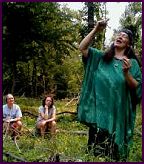 Susun S. Weed, herbalist, wise woman, and teacher for over two decades, is the founder of the Wise Woman Center in upstate New York and the author of four highly acclaimed books on alternative/complementary healthcare for women. Honored as a Peace Elder in 1996, Ms. Weed is respected worldwide as the voice of the Wise Woman tradition, the oldest tradition of healthcare on the planet.
The Wise Woman tradition maintains that health is flexibility and that deviations from normal (that is, problems) offer us an opportunity to reintegrate those parts of ourselves that we have cast out. This reintegration is accomplished through nourishment and the person emerges healed/wholed/holy. The Wise Woman tradition is compassionate and heart-centered. It honors the Earth and the special mysteries of women. It is simple, local, ecological, and invisible, choosing to use common plants, such as dooryard weeds, rather than exotic herbs from far away.
The Wise Woman Center, founded in 1984, is a safe place for women around the world to gather together to celebrate the wise woman within and to study herbal medicine and spirit healing with Susun and notable teachers such as Brooke Medicine Eagle, Z Buda pest, Vicki Noble, and Merlin Stone.
Ms. Weed has been called a backwards pioneer. She agrees: "I've gone backwards into prehistory, into herstory, to rediscover and rename something as ancient as humanity, but something which is perfectly relevant, indeed critical to our survival, today." That "some thing" is the Wise Woman tradition; a unique viewpoint from the distant past that she be lieves will help us find answers for our collective future.
The Wise Woman viewpoint that we are all connected and that a health crisis is symbolic as well as physical -- characterized by some as shamanic, by others as superstitious -- still exists in our society today, both in lay healing and in professions such as midwifery and psycho-therapy, but it usually goes unnamed. "One of the characteristics of this tradition is its integration into everyday life. By healing through nourishment, whether it is a hug or a special dinner, the wise woman acts invisibly whenever possible."
This is in marked contrast to other traditions of healing, according to Weed, who differ entiates three major healing traditions: the Scientific, the Heroic, and the Wise Woman. In the Scientific tradition the doctor is highly visible and the patient is reduced to a body part or a disease designation. In the Heroic or Holistic tradition, the healer is the one who knows the right way to do things and the patient must follow the rules in order to get well. In the Wise Woman tradition, illness is understood as an integral part of life and self-growth, with healer, patient and nature as co-participants in the healing process.
Much of today's alternative medicine comes from Heroic traditions, which traditionally emphasize fasting, purification, colonic cleansing, rigid dietary rules, and the use of rare botanicals in complicated formulae. Even much of metaphysical healing is applied this way: It views illness as a failure rather than a natural and potentially constructive process.
Susun Weed sees herself as a teacher, not a healer. "A healer is someone who does for you, while a teacher shows you how to do for yourself. When I work with a correspon dence course student or an apprentice, for instance, I'm working with the intention of helping her to know herself better, to learn how to listen to and nourish all parts of her self, which will allow her to become more healthy/whole/holy."
Susun reminds us that wellness and illness are not polarities. They are part of the contin uum of life. "We are constantly renewing ourselves, cell by cell, second by second, every minute of our lives. Problems, by their very nature, can facilitate deep spiritual and symnolic renewal, leading us naturally into expanded, more complete ways of thinking about and experiencing ourselves."
Ms. Weed maintains an active teaching/lecture schedule, with bookings throughout the U nited States, Canada, Australia, New Zealand, and Germany (where she also trains ap prentices). She has taught at many prestigious schools including the National College of Naturopathic Medicine, Yale Nursing School, South Florida Midwifery School, Rocky Mountain Center for Botanical Studies, and the Waikato College of Herbal Studies. She currently sits on advisory boards for the California Institute of Integral Studies and the National Institute of Health's Rosenthal Center for Alternative/Complementary Medicines at Columbia University.
Ms.Weed is most well-known for her books, which are variously described as informa tive, inspirational, and accessible. Her poetic and humorous style have endeared her to over half a million readers, who treasure her voice, the voice of the Wise Woman way.


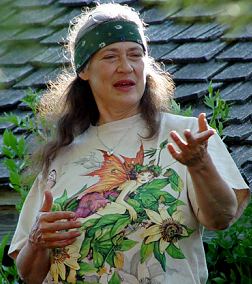 Susun Weed encourages women to work towards good health from the inside out. Her close-to-the-earth approach continues to break new ground in old ways, helping to make natural non-invasive solutions available to women from every walk of life.