Evening Primrose - Oenothera biennis
by Dr. Thea Summer Deer
©2013
It all began a long time ago when Susun came to Tucson. She had come to put the finishing touches on The Menopausal Years with her editor, Betsy Sandlin. It was 1992. Betsy was in the midst of her change and I was just beginning mine.
A mutual friend of ours, who knew that I had previously worked with Susun, gathered us together one morning for a hike through the saguaros beneath Mount Lemmon in the Santa Catalina Mountains. Mount Lemmon is named in honor of the botanist Sarah Plummer Lemmon, who trekked to the top by mule and foot with Native American guides in the late 1880s. Called “Frog Mountain” by native Tohono O’odham people, it is a granite massif above the heart of the city.
As we retraced Sarah’s footsteps at the base of this city’s backyard wilderness, I confessed to Susun that I was experiencing heavy menstrual bleeding and was concerned. “Oh! You’re experiencing menstrual flooding are you?” she responded. A flood it was. Welcome to perimenopause. I was relieved to have the diagnosis, but I was only in my late thirties. The important part of this story is what came next – Evening Primrose. Susun suggested that I take 4-8 capsules of evening primrose seed oil daily for six weeks, coupled with vitex berries to stabilize progesterone shifts and decrease flooding. She even offered to send me a Xeroxed copy of her as yet unpublished manuscript with the protocol, which she did. It worked like a miracle. I will be forever grateful for the synchronicity of that morning and the information that I now get to share with you as we pass it down in the Wise Woman Tradition.
In the desert southwest the fragrant tufted evening primrose, Oenothera caespitosa, is a southwestern species that first blooms white, but turns pink or light magenta. Most native desert species are white. The evening primrose that most of us are familiar with is the yellow flowering variety in a genus of about 125 species. Native to North and South America it is not closely related to the true primroses (Primula).
Evening Primrose is a biennial wildflower with opposite leaves and pale yellow flowers, which
bloom in July and August. The flowers open in the evening but stay open for most of the following day. They can be seen on a dark night from a distance when there is no other light source available, possibly due to some phosphoric property in the flowers.
Moths and certain bees that are morphologically specialized to gather this pollen effectively pollinate the flowers. Evening primrose tends to germinate in disturbed soil, growing wild throughout North America in pastures and fields, but may eventually being out-competed by other species. This may explain why it was so profuse in the pasture next to my house last year and nowhere to be seen this year. It is cultivated in North and South America and Europe for its seed oil. Seeds ripen from late summer to fall.
Evening primrose oil, an omega-6 EFA, contains high amounts of GLA. The mature seeds contain up to 10% GLA and 70% linoleic acid. The seed oil of O. biennis is used clinically in Britain to reduce the symptoms of PMS, most notably the pain of menstrual cramps and breast tenderness. It may even protect against breast cancer. Additionally evening primrose oil is thought to aid in fertility by improving the quality of the mucus lining the cervix. The oil extracted from its seeds has long been a favorite of women for female reproductive disorders. Midwives use it both orally and apply it to the cervix to aid in ripening for birth.
This natural polyunsaturated fatty acid is an effective anti-inflammatory; it is used to ease the symptoms of arthritis, colitis, diabetic neuropathy, hypertension and high cholesterol as well as dry skin conditions and eczema. It eases prostate swelling in older men, too. Evening primrose oil is considered a carrier oil in the world of aromatherapy and is prized for its abundant food, health, cosmetic and medicinal benefits. This oil is a rich source of GLA, the precursor of linoleic acid, and an unusual long-chain fatty acid found in only three other plants: black currants, borage seeds, and hemp seeds. Because the human body needs a balance between omega-6 and omega-3 essential fatty acids it is recommended to use evening primrose in combination with fish oil containing omega-3 EFA’s.
After leaving Tucson and moving back east to the Appalachian Mountains I was delighted to find evening primrose growing in my yard. The Cherokee use it as a food source eating the leaves as greens and boiling the young root. While I had been introduced to many naturalized European imports in my herbal studies, it was refreshing to discover a native of North America that had been successfully introduced in Europe and naturalized in England as a garden escapee.
Evening Primrose continues to be an ally for me, even after menopause aiding in keeping my heart healthy, reducing inflammation and alleviating arthritis. As I was reviewing my notes for this article I found the Xeroxed copy of that manuscript Susun had sent me so long ago. In the margin was a handwritten note from Susun and I quote:
“Betsy and I discovered we both thought of you as anything but ‘Cynthia!’ Hope you don’t object to my shortening your name to ‘goddess,’ Thea.” Well, of course I didn’t object to being called a goddess! And that’s how I not only met a new herbal ally, but also received a new name. The name stuck and so did the plant. Evening primrose is a plant that serves the goddesses well.
References:
New Menopausal Years, by Susun Weed
Delmar’s Integrative Herb Guide for Nurses, by Martha Libster
A Modern Herbal, by Mrs. M. Grieve
Frog Mountain Blues, by Charles Bowden
Photos by Nicholas
Register now for Thea Summer Deer’s work-at-your-own-pace class, Heal Your Heart: Summer & the Fire Element at Wise Woman University.
From Thea Summer Deer :
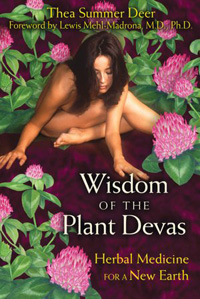
Wisdom of the Plant Devas:
Herbal Medicine for a New Earth
by Dr. Thea Summer Deer
Each plant has a story to share with us, a healing story to guide us in trying times, a spirit medicine for the New Earth that is presently unfolding. Herbs are some of the most powerful allies we have for these transitional times--we just need to learn how to listen as they share their knowledge with us.
Order at: www.wisewomanbookshop.comback to articles index
back to press kit
© Susun Weed -Wise Woman Center
~ Disclaimer & Privacy Policy ~